Face Roller Benefits: Do They Actually Work?
July 29, 2026 · 9 min read
Written by the MissBiotics Beauty Team — probiotic-inspired beauty specialists.
The short answer
Face roller benefits are genuine but modest. A chilled roller moves interstitial fluid, so a puffy morning face looks flatter for a few hours. The massage feels good and helps serum spread evenly. However, rolling does not build collagen, lift sagging tissue or remove wrinkles, and the research base is small and short-term. Buy one for comfort and de-puffing, not for a facelift.
Face Roller Benefits: What the Evidence Actually Shows
Face roller benefits are real, yet they are smaller and shorter-lived than the marketing suggests. That is the honest answer, and it is the one we give at our New York and London counters every single week. A chilled roller moves interstitial fluid, so a puffy face looks flatter within minutes. Furthermore, the massage feels genuinely pleasant, and it helps a serum spread evenly instead of pooling in patches.
However, no roller builds collagen. No roller lifts sagging tissue. No roller erases a wrinkle. In summer 2026 the tool aisle is louder than ever, so we want to draw a clear line between the effect you can feel today and the transformation you have been promised. The first is dependable. The second is not.
Here is the definitive framing. A face roller is a comfort and de-puffing tool, not an anti-aging treatment. Once you accept that, a $24.99 roller becomes excellent value rather than a disappointment waiting to happen.
Face roller benefits, ranked by how solid the evidence is
Temporary de-puffing sits at the top, because the mechanism is simple physics. Cool pressure moves fluid that has pooled overnight toward the lymph nodes near your ears and neck. Cleveland Clinic notes that the gentle downward motion of gua sha may help get lymphatic fluid moving, which may lessen facial puffiness. Meanwhile, it also says plainly that research does not directly address the puffiness claim.
Better product application ranks second. A few minutes of slow massage spreads serum across the whole face, and it stops you from rushing. Relaxation ranks third, and it matters more than beauty writers admit. Structural change ranks last, because the evidence for it is thin, small-scale and short-term.
Face Roller vs Gua Sha: Pressure, Purpose and Feel
These two tools get lumped together, yet they do different jobs. A roller glides. A gua sha stone drags. That single difference changes the pressure, the pace and the result you feel afterward.
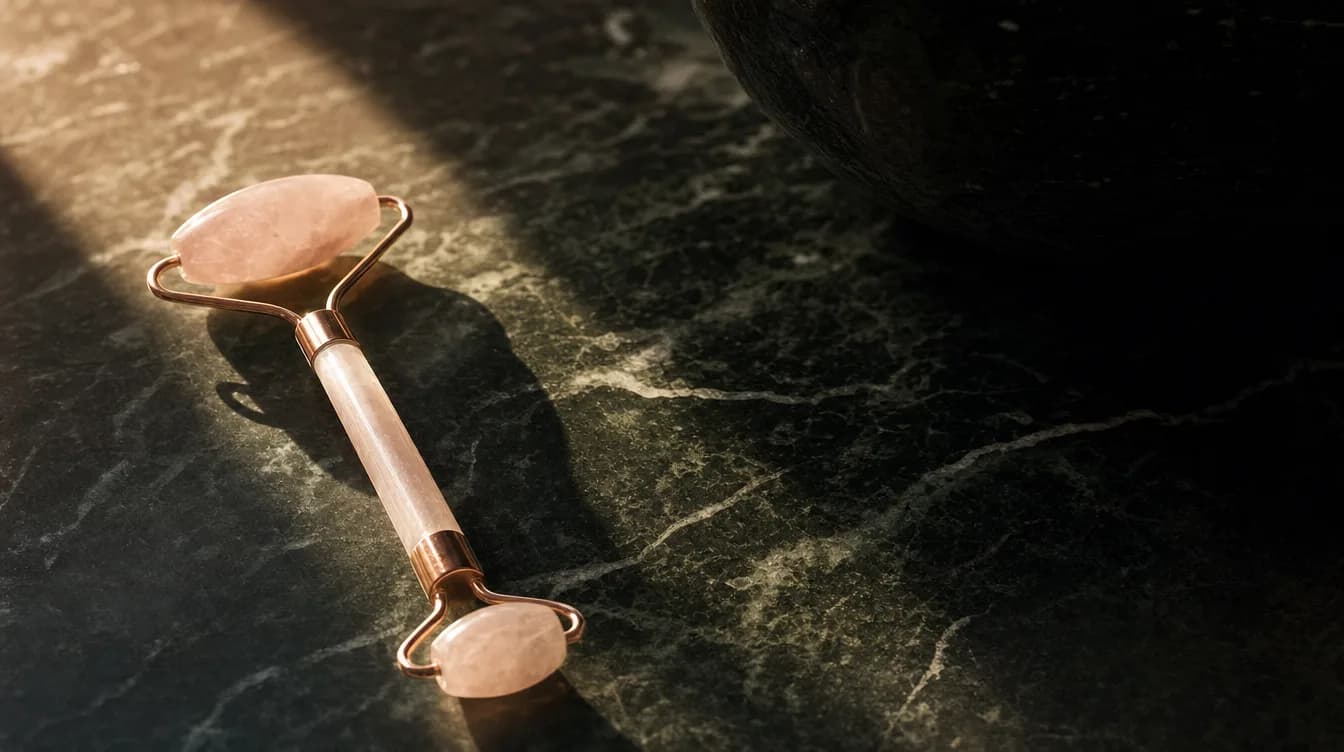
A roller is a wheel of stone on a handle, usually jade or rose quartz. It moves quickly, applies light and even pressure, and stays cool against the skin. Therefore it suits fluid movement and gentle serum spreading. It is also the easier tool to learn, which is why most people should start there.
Gua sha is a technique, not only an object. A flat stone is held almost flush to the face and pulled slowly along one line at a time. Consequently the pressure is firmer, the contact area is larger, and the sensation reaches muscle rather than surface. We do not sell a gua sha stone at MissBiotics, so treat this section as neutral guidance rather than a pitch.
One 2025 randomized trial gives a useful hint about the split. Thirty-three women aged 20 to 50 massaged for 10 minutes, five times a week, for eight weeks. Gua sha changed muscle-tone measures. The roller instead nudged skin-elasticity readings. Both groups saw facial contour distances shrink by roughly 2 to 3 millimeters. Note the unit: millimeters, in a small study, with no untreated comparison group.
- Roller: light pressure, fast glide, best for de-puffing and spreading product.
- Gua sha: firmer pressure, slow single strokes, aimed at muscle tension and jaw tightness.
- Roller wins on ease; gua sha wins on depth of sensation.
- Face roller benefits appear within minutes, then fade within hours. Both tools behave that way.
- Neither tool substitutes for sunscreen, sleep or a dermatologist.
What a Face Roller Will Not Do
This is the passage most brands skip, so we will be blunt. A face roller will not build collagen. Collagen production responds to sun protection, retinoids, certain in-clinic procedures and time. It does not respond to a stone wheel pressed against your cheek for four minutes.
A roller will not permanently lift anything. Sagging is a story of bone, fat pads and ligaments, and rolling cannot reposition any of them. It will not remove wrinkles either. Additionally, it will not drain toxins, because your liver and kidneys already handle that job without help from a cosmetic tool.
The evidence base here is genuinely thin, and honesty requires saying so. A 2025 systematic review of conservative mechanical facial rejuvenation techniques looked at facial exercise, massage and related devices across 321 participants. Its verdict was that current evidence remains insufficient to establish efficacy with confidence. The review flagged small samples, no standardized protocols, mostly subjective measures and no long-term follow-up.
For context, the American Academy of Dermatology says sunscreen and moisturizer are the two most effective anti-aging products you can buy, and that anti-aging products deliver modest results. If a cream cannot match a facelift, a roller certainly cannot. In practice, that is fine. Face roller benefits are worth having on their own terms.
A customer who expected a facelift
Last spring a customer came back to our London counter frustrated. She had rolled every morning for six weeks and saw no lift along her jaw. She wanted a refund, and we understood why.
So we asked what had changed. Her morning puffiness was noticeably better. Her serum was finally covering her whole face. She had four calm minutes before a stressful commute. In short, she had received every real benefit and none of the imaginary one. She kept the roller, and she stopped expecting it to do a surgeon's work.
How to Use a Face Roller: Direction, Pressure and Slip
Technique is where most people go wrong, and the fixes are quick. Work outward and downward, always. Start at the center of the face and finish near the ears, then sweep down the sides of the neck toward the collarbones. That is the direction lymph naturally travels.
Use four to six slow strokes per zone, and cover five zones: forehead, under-eyes, cheeks, jaw and neck. A full pass takes three to five minutes. Never scrub back and forth; Cleveland Clinic advises keeping the tool moving in a smooth, straight line rather than up and down or at random angles.
Pressure should be light enough that you barely blanch the skin. If you see redness afterward, you pressed too hard. Furthermore, drag is your enemy. Skin needs slip, so apply a facial oil, a light serum or a mist first. A spritz of S.he Rose Water Facial Spray at $7.99 gives just enough glide for a roller without making the stone slide uncontrollably.
How often, and when to judge results
Daily is fine, and once a day is plenty. Three to five minutes each morning captures nearly all the available de-puffing. Rolling for twenty minutes does not multiply the effect; it simply irritates skin and eats your morning.
Give it two weeks before you form an opinion, and judge only the honest outcomes: morning puffiness, comfort and product spread. If you are hunting for firmness after eight weeks, you are measuring the wrong thing. Meanwhile, chill the roller in the refrigerator for 15 to 20 minutes beforehand, because cold does more of the de-puffing work than the rolling does.
Avoid rolling over active acne, broken skin, sunburn or a fresh cosmetic procedure. Additionally, skip it if you bruise easily or take blood thinners without checking with your doctor first. The realistic ceiling on face roller benefits is a fresher-looking morning, so there is no reason to push through discomfort for it.
Who Benefits Most, Plus Cleaning and Storage
Some people get far more from a roller than others. If you wake up puffy, you will notice the difference immediately. Harvard Health notes that excess fluid retention can be triggered by eating too much salt, heat, drinking alcohol or standing for a long period. Anyone whose face reflects a salty dinner or a hot night is the ideal candidate.
Contact-lens wearers, frequent fliers and anyone who clenches their jaw also tend to become converts. Meanwhile, people with very reactive or rosacea-prone skin often do better without the friction. If your skin flushes at the slightest touch, this is not your tool.
Cleaning is non-negotiable, and most people neglect it. Wipe the stone after every session, then wash it properly once a week with a drop of gentle cleanser and lukewarm water. Dry it fully before storing. Never soak the handle, because water loosens the axle on a rolling head. We apply the same logic to every tool that touches your face, which is why our guide to how often to clean makeup brushes is one of our most-read pieces.
- Best for: morning puffiness, jaw tension, dry serum application, anyone who wants a calm four minutes.
- Less suitable for: active breakouts, rosacea-prone flushing, broken or sunburned skin.
- Clean weekly with gentle cleanser and lukewarm water; dry fully before storage.
- Chill 15 to 20 minutes in the refrigerator, not the freezer, to avoid cracking the stone.
- Store flat in a pouch, away from the edge of a hard basin. Dropped stone tools chip.
Where face roller benefits fit in a routine
Morning suits rolling best, because that is when fluid has pooled. Cleanse, mist, then roll, then apply moisturizer and sunscreen. Our morning beauty ritual sets out the full order if you want a template.
Evening rolling is more about relaxation than appearance, and it pairs well with the slower steps in our evening skincare ritual. Therefore choose your slot based on the outcome you want, not on habit.
How MissBiotics Can Help
We sell tools, so we have an obvious incentive to overclaim. We would rather keep your trust. Everything below is a real MissBiotics product at its real price, described for what it actually does: soothe, comfort and support product application. None of it treats a condition.
- Start here: the Rose Quartz Facial Roller Set at $24.99 is our core recommendation, with a large head for cheeks and a small head for under-eyes.
- For tired eyes: the Celavi Eye Massager at $5.99 gives gentle vibration in the smallest, puffiest zone.
- For jaw and body tension: the Face and Body Cupping Therapy Set at $14.99 uses suction rather than glide, and it is a different sensation entirely.
- Slip and de-puffing: a mist of S.he Rose Water Facial Spray or the S.he Cucumber and Green Tea Facial Spray at $7.99 each.
- Cold comfort: chilled hydrogel eye patches at $4.99 or a cucumber facial mask at $2.99 for the mornings you skip the roller.
- Keep it clean: the Celavi Facial Cleanser Set at $5.99 washes both your face and your stone.
- Browse the full tools shelf or the wider skincare shelf, and read the MissBiotics rituals in order.
Matching the tool to your decade
Puffiness patterns change with age, and so does the right expectation. Our campus years guide leans on late-night recovery, while the prime focuses on consistency and golden hour prioritizes comfort over correction.
If you would rather not guess, our free consultation builds a short routine around your skin, your climate and the four minutes you actually have. And if today's other question is festival-related, our guide to festival glitter makeup covers the removal side of a long night.
Conclusion: Worth It, With Honest Expectations
So are face rollers and gua sha tools worth it? Yes, if you buy them for the right reasons. The de-puffing is real and temporary. The massage is pleasant and improves how your products go on. The lifting, tightening and collagen-building claims are not supported by good evidence, and the research that exists is small, short and mostly measured in millimeters.
In short, the honest verdict on face roller benefits is this: a genuine daily comfort at a modest price, worth five minutes and around $25, and never a substitute for sunscreen, sleep or professional advice. Judge it after two weeks on puffiness alone, and you will probably keep using it for years.
Ready to try one? Start with the Rose Quartz Facial Roller Set, browse the rest of the tools shelf, or book a free MissBiotics consultation and we will tell you honestly whether you need a tool at all.
Questions, answered
Do face rollers actually work?+
Yes, for temporary de-puffing and pleasant massage, and no for lifting or collagen. A chilled roller moves interstitial fluid, so a puffy face looks flatter for a few hours. It also helps serum spread evenly and forces you to slow down. It does not change facial structure or firmness.
Is gua sha better than a face roller?+
Neither is better; they do different jobs. A roller glides with light pressure and suits fluid movement and product spreading, while gua sha uses slow, firmer single strokes and reaches muscle tension. A 2025 trial found gua sha shifted muscle-tone measures and a roller shifted skin-elasticity readings. Beginners generally find a roller easier to use correctly.
How often should I use a face roller?+
Once a day is plenty, and three to five minutes is enough. Mornings work best because that is when fluid has pooled overnight. Rolling for longer does not increase the effect and can irritate skin. Give it two weeks before judging, and judge puffiness rather than firmness.
Which direction should I roll?+
Always roll outward and downward, from the center of the face toward the ears, then down the neck to the collarbones. Use four to six slow strokes per zone across forehead, under-eyes, cheeks, jaw and neck. Keep each stroke in a smooth straight line rather than scrubbing back and forth.
Do I need to use oil or serum with a face roller?+
Yes, some slip is essential. Dragging a stone across dry skin tugs and can cause irritation or redness. A facial oil, a light serum or a hydrating mist gives enough glide while still letting the tool grip. Apply it first, then roll, then finish with moisturizer and sunscreen.
Can a face roller build collagen or lift my jawline?+
No. Collagen production responds to sun protection, retinoids, in-clinic procedures and time, not to mechanical rolling. Sagging involves bone, fat pads and ligaments that a cosmetic tool cannot reposition. A 2025 systematic review concluded that evidence for mechanical facial rejuvenation techniques remains insufficient to establish efficacy with confidence.
How do I clean and store a face roller?+
Wipe the stone after every use and wash it weekly with a drop of gentle cleanser and lukewarm water. Dry it completely before storing, and never soak the handle, because water loosens the rolling axle. Store it flat in a pouch, and chill it in the refrigerator rather than the freezer to avoid cracking.
When should I see a doctor about puffiness instead?+
Please see a dermatologist or your GP for puffiness that persists, worsens or arrives suddenly, and for any swelling with pain, redness, fever or vision changes. Ongoing fluid retention occasionally reflects something that deserves proper assessment. Cosmetic tools soothe, comfort and support product application; they never treat, cure or prevent disease, and they are no substitute for professional advice.
Sources & further reading
- Cleveland Clinic — Gua Sha: Benefits and How To Do It: gentle downward motion may move lymphatic fluid and lessen facial puffiness, strokes should be smooth and straight, and there is not enough high-quality research to declare the benefits definitively
- PMC — Efficacy of Conservative Techniques for Mechanical Facial Rejuvenation: A Systematic Review (2025): current evidence remains insufficient to establish efficacy with confidence, with small samples and no long-term follow-up
- PMC — Comparative Effects of Facial Roller and Gua Sha Massage on Facial Contour, Muscle Tone, and Skin Elasticity: randomized trial of 33 women, 10 minutes five times weekly for eight weeks, contour changes of roughly 2 to 3 mm
- American Academy of Dermatology — How to select anti-aging skin care products: sunscreen and moisturizer are the two most effective anti-aging products, and such products deliver modest results
- Harvard Health — Easing summer swelling: excess fluid retention can be triggered by too much salt, heat, alcohol or standing for a long period
- American Academy of Dermatology — Face washing 101: use a gentle, non-abrasive, alcohol-free cleanser and resist scrubbing the skin