Find Your Foundation Shade: The Undertone Guide
July 27, 2026 · 10 min read
Written by the MissBiotics Beauty Team — probiotic-inspired beauty specialists.
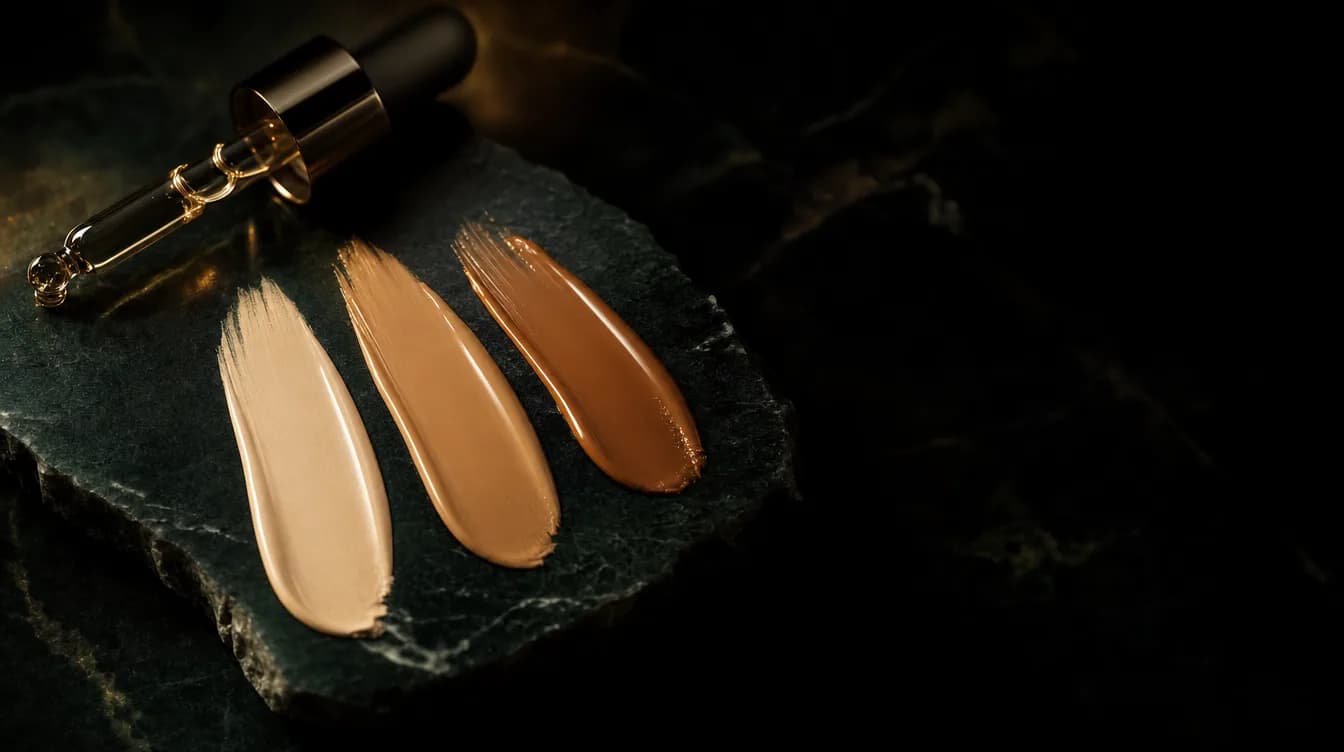
The short answer
To find your foundation shade, you match two things: depth (light, medium, or deep) and undertone (warm, cool, or neutral). Swatch three stripes along your jawline, never your hand, then check them in natural daylight. Read the veins on your inner wrist too, since green suggests warm and blue suggests cool. Give a base ten to fifteen minutes to settle before you judge it.
Find Your Foundation Shade: Start With Depth and Undertone
The fastest way to find your foundation shade is to stop treating it as one decision. It is two. First you settle depth, meaning how light or deep your skin reads. Then you settle undertone, meaning the warmth or coolness underneath. Get both right and the base disappears into your skin. Get one wrong and it sits on top like a mask, however good the formula is.
Most mismatches we see at the counter come from skipping the second step entirely. Someone picks a shade that looks close in depth, yet the undertone fights their skin. Consequently the face looks grey, orange, or oddly pink next to the neck. That said, undertone is not mysterious once you know the tests, and the whole check takes about five minutes in good light.
Skin depth itself is simply melanin. The amount, size, and distribution of melanin decides how light or deep your skin appears, which is why depth sits on a continuous scale rather than in tidy boxes. Undertone, meanwhile, is the constant beneath a tan. Therefore you match both, and you match them where your face actually meets your neck.
- Depth answers how light, medium, or deep your skin reads on a scale.
- Undertone answers whether that skin leans warm, cool, or neutral underneath.
- The jawline is the honest meeting point between your face and your neck.
- Natural daylight is the only reliable judge of a swatch.
- A base needs ten to fifteen minutes to settle before its true colour shows.
How to find your foundation shade in three checks
If you want the short version, run these three checks in order. First, place your depth on the light, medium, or deep scale by looking at your bare, unlit face. Second, read your undertone using the wrist and jewellery tests below. Third, swatch two or three candidate shades along the jawline and wait.
Additionally, do all of this on clean, moisturised skin. A base always shifts slightly over a fresh moisturiser, so testing on bare, flaky, or overly oily skin gives you a false read. The S.he Flawless Stay Foundation at $7.99, for example, settles differently on prepped skin than on stripped skin.
Depth: Placing Yourself on the Light, Medium, or Deep Scale
Depth is the easy half, and it is the one people usually get roughly right. Stand at a window with no makeup on and look at the centre of your face. Light skin shows quickly in the sun and often carries visible pink or freckling. Medium skin holds a light tan and rarely looks stark against white paper. Deep skin carries rich, even colour with obvious warmth or coolness woven through it.
However, the mistake is matching depth to the back of your hand. Hands are usually darker or more weathered than the face and neck, so they push you toward a shade that looks muddy up top. Meanwhile the jawline and neck tell the truth, because that is the join everyone actually sees.
One more depth note for summer. Skin deepens with sun exposure, so a base bought in January may read too light by late July. Therefore many people keep two neighbouring shades and mix, or size down a full-coverage base such as the Liquid Foundation Demi-Matte Finish Full Coverage at $6.99 that they can sheer out with moisturiser when they pale off again.
- Judge depth at the centre of a bare, daylit face, not under bulbs.
- Never depth-match to the back of your hand, which usually runs darker.
- Keep two neighbouring depths through summer and blend as your tan shifts.
- A fuller base can be sheered with moisturiser when your skin lightens again.
Undertone: Warm, Cool, or Neutral, and the Vein Test
Undertone is where matching succeeds or fails. There are three families. Warm undertones lean golden, peachy, or yellow. Cool undertones lean pink, red, or bluish. Neutral undertones sit in the middle, with no single cast winning. Crucially, undertone is independent of depth, so light skin can be warm and deep skin can be cool.
The wrist vein test is the quickest read. Turn your inner wrist to natural light and look at the veins. Green-looking veins suggest a warm undertone. Blue or purple veins suggest a cool undertone. A genuine mix of both usually means neutral. It is a guide rather than a lab result, so pair it with a second check before you commit.
For that second check, use jewellery and white fabric. Warm skin tends to flatter gold and looks healthy beside cream or ivory. Cool skin tends to flatter silver and looks fresh beside pure white. Furthermore, ask how your skin behaves in strong sun: reliable tanning without burning leans warm, while quick burning and pinking leans cool.
- Warm undertone: golden or peachy cast, flatters gold, tans more easily.
- Cool undertone: pink or bluish cast, flatters silver, burns more easily.
- Neutral undertone: balanced cast, wears both metals, no strong lean.
- Vein test: green reads warm, blue or purple reads cool, a mix reads neutral.
Reading undertone shorthand on the label
Brands code undertone into shade names, and the shorthand is worth learning. Letters or words like W, golden, honey, and beige usually signal warm. C, cool, rose, and porcelain usually signal cool. N and neutral sit between them. However, coding is not standardised across brands, so treat the label as a starting point and let the jawline swatch settle the argument.
If your undertone genuinely shifts with the seasons, a correcting layer helps more than a new base. That is where a corrector like the Nabi All-In-One Correcting Concealer with Brush at $4.99 earns its place, neutralising a cast before your true-match base goes over the top.
Where to Swatch: The Jawline Rule and Natural Light
Here is the rule that fixes most bad matches: to find your foundation shade, swatch on the jawline, then walk to a window. Draw two or three thin stripes of your candidate shades down from the jaw onto the upper neck. The shade that vanishes is your match. If you cannot make one disappear, you are between shades and should mix the two closest.
Lighting decides everything at this stage. Store bulbs are often yellow or harsh, which flatters some shades and libels others. Consequently a base that looked perfect at the counter can turn sallow outdoors. Therefore judge every swatch in daylight near a window, or step outside with a mirror. Natural light is the only honest referee.
Give the swatches time, too. Most foundations oxidise slightly as they warm and react with skin oils and air, so the colour you see at minute one is not the colour you wear at minute fifteen. As a general practice we wait ten to fifteen minutes before judging a swatch, which is long enough for any darkening or warming to show. A blending tool such as the Celavi Macaron Beauty Sponge Set at $5.99 also affects the finish, since a damp sponge sheers colour while a brush builds it.
- Draw two or three stripes down the jawline onto the upper neck.
- The shade that disappears is your match; if none does, mix the closest two.
- Judge only in natural daylight, never under store or bathroom bulbs.
- Wait ten to fifteen minutes so oxidation shows before you decide.
Why bases oxidise, and how to stop the orange
Oxidation is normal chemistry, not a fault. As a base meets air, skin oil, and warmth, some formulas deepen or warm by a shade, which is where the dreaded orange cast comes from. Oilier skin tends to push this further, so a base one notch too warm at swatch can turn markedly orange by lunchtime.
Two moves keep it in check. First, choose a shade a touch cooler or lighter than looks perfect at minute one, letting oxidation carry it to true. Second, control oil at the source. The American Academy of Dermatology advises oil-free, water-based, matte formulas for oily skin, and a light setting step over a mattifying base slows the shift considerably.
Matching Your Concealer to Foundation and Under-Eyes
Concealer is not just a lighter foundation, and matching it wrongly undoes a good base. For blemishes and redness, your concealer should match your foundation almost exactly, so it blends into the base rather than leaving a pale patch. A shade that is too light simply highlights the very spot you wanted to hide.
Under the eyes, the rule flips. Here a concealer roughly one shade lighter than your foundation lifts shadow and brightens, because the goal is to bounce light rather than to colour-match skin. However, keep it within your undertone family: a warm base wants a warm-leaning brightener, or the under-eye reads ashy and grey.
Placement and prep matter as much as shade. Set the eye area gently so a lighter concealer does not travel into fine lines, and prep puffy mornings first. A cooling step like the Hydrogel Eye Patch at $4.99 de-puffs and smooths the surface, so concealer sits flat instead of creasing. For everyday coverage, the Nabi All-In-One Concealer with Brush at $4.99 keeps the tool and product together for quick touch-ups.
- Blemish concealer: match your foundation almost exactly to blend it away.
- Under-eye concealer: go about one shade lighter to brighten, not to match.
- Stay inside your undertone family so brighteners never turn ashy.
- De-puff and prep the eye area first so lighter concealer will not crease.
The tools that make a match look seamless
Even a perfect shade fails with the wrong application. A dense Foundation Brush at $24 lays base evenly across the jaw join, where mismatches usually betray themselves. Meanwhile a precise Concealer Brush at $15 places product exactly on a blemish without wiping out the surrounding base.
For sheerer, skin-like coverage, a damp sponge such as the Celavi 8pc Flower Blending Sponge at $4.99 presses colour in rather than painting it on. Clean tools matter here too, since buildup drags product and fakes a mismatch; our guide on how often to clean makeup brushes sets out the schedule.
How MissBiotics Can Help You Match With Confidence
Our probiotic-inspired approach helps you find your foundation shade by starting with the skin, not the shade card. A base always sits better on a balanced, well-prepped surface, which is why we treat moisturising and light prep as part of matching rather than a separate ritual. The American Academy of Dermatology puts makeup last in the routine, after cleansing, treating, and moisturising, and our rituals follow that same order.
For the base itself, two Face options cover most needs. The S.he Flawless Stay Foundation at $7.99 gives a long-wear finish for warmer days, while the Liquid Foundation Demi-Matte Finish Full Coverage at $6.99 offers buildable coverage you can sheer with moisturiser. Pair either with the Nabi All-In-One Concealer with Brush at $4.99 for spots and the Nabi All-In-One Correcting Concealer with Brush at $4.99 when an undertone needs neutralising.
Browse the full Face range for bases and concealers, or the Tools range for the brushes and sponges that make a match seamless. However, if you would rather have someone confirm your depth and undertone in person, book a consultation and we will swatch it with you. For summer wear, our notes on a sweat-proof mascara for summer round out a base that has to survive the heat.
Ready to Find Your Match
The whole method fits on one line. To find your foundation shade, place your depth on the light-to-deep scale, read your undertone with the vein and jewellery tests, swatch along the jawline, and judge only in daylight after ten to fifteen minutes. Do that and the base will read as skin, not makeup.
So make your next base a considered one rather than a lucky guess. Explore the Shop to compare our foundations and concealers side by side, or book a consultation if you want our team to confirm your undertone before you commit. Additionally, prep the skin underneath well, because a good match on cared-for skin always outperforms a perfect shade on tired skin.
Questions, answered
How do I find my foundation and concealer shade?+
Match depth and undertone separately. Place your depth on the light, medium, or deep scale using a bare, daylit face, then read your undertone with the wrist-vein and jewellery tests. Swatch two or three shades along the jawline, wait ten to fifteen minutes, and pick the stripe that disappears. Match blemish concealer to that base, and go one shade lighter under the eyes.
How do I know my undertone?+
Use the vein test first: look at your inner wrist in daylight, where green veins suggest warm and blue or purple veins suggest cool. Confirm it with jewellery, since gold flatters warm undertones and silver flatters cool ones. A genuine mix of signals usually means you are neutral and can wear both.
Should concealer be lighter than foundation?+
Only under the eyes, where about one shade lighter brightens shadow. For blemishes and redness, your concealer should match your foundation almost exactly, so it blends in rather than leaving a pale mark. In both cases, stay within your undertone family, or a lighter concealer can look ashy and grey.
Why does my foundation turn orange?+
It is usually oxidation. As a base meets air, skin oil, and warmth, many formulas deepen or warm by a shade over the first fifteen minutes. Oily skin pushes this further. Choose a shade a touch cooler or lighter than looks perfect at first, and use an oil-free, mattifying formula to slow the shift.
How do I match foundation without testers?+
Match to the shade coding and your known depth and undertone. Warm codes include golden, honey, and W; cool codes include rose, porcelain, and C; N means neutral. Buy two neighbouring shades if you can, since mixing lets you correct a near-miss, and always test on the jawline once the base arrives.
Where should I swatch foundation on my body?+
On the jawline, drawing stripes down onto the upper neck, never on the back of your hand. The hand usually runs darker or more weathered than the face, which pushes you toward a muddy match. The jaw-to-neck join is the boundary everyone actually sees, so a shade that disappears there is your true match.
Does foundation shade change in summer?+
Yes, because sun exposure deepens skin as melanin increases. A base bought in winter can read too light by late July. Keep two neighbouring shades and blend as your tan shifts, or choose a buildable base you can sheer with moisturiser when your skin pales off again.
Should I test a new foundation before wearing it out?+
Yes, especially if your skin reacts easily. Dermatologists suggest applying a new product to a small area, such as the inner arm, for several days before full use to check for irritation. If a base triggers persistent redness, itching, or breakouts, stop using it and speak to a dermatologist or your GP.
Sources & further reading
- NCBI StatPearls, Biochemistry of Melanin — supports that skin depth reflects the amount, type, and distribution of melanin rather than the number of melanocytes
- American Academy of Dermatology — supports the advice to choose oil-free, water-based, matte formulas for oily skin to reduce shine and shifting
- American Academy of Dermatology — supports placing makeup last in the routine, after cleansing, treating, and moisturising
- American Academy of Dermatology — supports patch-testing a new product on a small area for several days before full use
- American Academy of Dermatology — supports watching for separation and spoilage in foundation and replacing it within its safe window