History of False Eyelashes: 1911 to 2026
September 20, 2026 · 9 min read
Written by the MissBiotics Beauty Team — probiotic-inspired beauty specialists.
The short answer
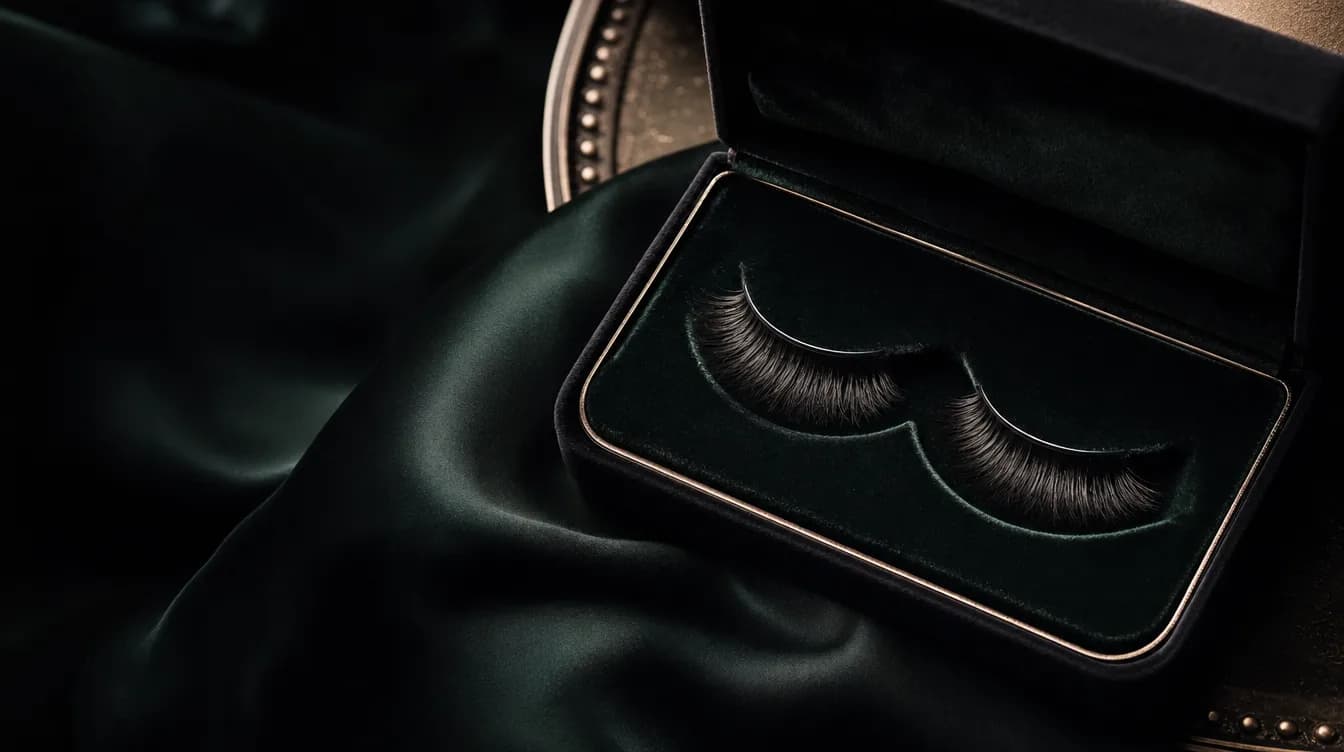
The history of false eyelashes is shorter than most people assume. Canadian inventor Anna Taylor patented a fabric-and-hair lash strip in the US on June 6, 1911, five years before director Griffith commissioned a gauze-and-hair lash for actress Seena Owen in the 1916 film Intolerance. German-born hair specialist Karl Nessler had already patented a similar design in the UK in 1902. Today's strip lashes, including MissBiotics' own human hair and faux mink styles, still use that same hair-on-a-band format.
The History of False Eyelashes Begins Long Before Any Lash Existed
The history of false eyelashes does not start with a strip of hair glued to an eyelid. Instead, it starts thousands of years earlier, in the eye cosmetics of ancient Egypt and Mesopotamia. Around 4000 BCE, Egyptians ground minerals such as galena and malachite into a dark powder called kohl. In practice, they mixed the powder with soot, moistened it with saliva, and lined the eyes using a stick of wood, bone, or metal. Notably, this eye makeup was worn by both men and women across Egyptian society, not only by royalty. Similarly, Greeks and Romans later adopted a related substance they called kollurion. However, none of these cultures glued individual hairs or fabric strips onto the lash line itself. Ultimately, that distinction matters if this story is going to be told honestly.
Kohl shaped the *idea* behind dramatic eyes without literally inventing false lashes. For example, defined, darkened eyes signaled beauty and status across Egyptian, Greek, and Roman society alike. Additionally, some historians note a practical side benefit: reducing sun glare, similar to the grease modern athletes still wear under their eyes. Still, no surviving Egyptian, Greek, or Roman artifact shows an attached lash extension or strip. Importantly, the false eyelash proper, the format MissBiotics still sells today, would not arrive for several more millennia.
Archaeologists have also recovered kohl pots and applicator sticks from Egyptian tombs, which suggests the cosmetic carried ritual weight alongside its daily use. That detail describes kohl, however, not an attached lash of any kind. Keeping those two traditions separate is part of telling this history accurately rather than smoothing over the gap for a tidier story.
The History of False Eyelashes: Why Kohl Was Not a False Lash
It helps to picture the actual difference. Kohl was applied directly to the skin around the eye, much like today's eyeliner. Instead, a false eyelash is a separate object, fabric or hair attached along the lash line and removed at the end of the day. Furthermore, kohl's ingredients included lead-based galena. Modern science now links that mineral to health risks with repeated exposure, which is part of why eye cosmetics moved away from it entirely. The two traditions are related in spirit. In short, they are not the same product, and conflating them muddies an otherwise well-documented history.
Who Invented False Eyelashes? Karl Nessler and Anna Taylor's Early Patents
The real history of false eyelashes begins in early twentieth-century Europe, not ancient Egypt. In 1902, German-born hair specialist Karl Nessler patented a method for manufacturing artificial eyebrows and eyelashes in the United Kingdom. Notably, Nessler is better known today as the inventor of the permanent wave. Even so, by 1903 he was selling artificial lashes under the name Nesto Lashes from his salon on Great Castle Street in London. Notably, each pair used real hair sewn onto a thin fabric base.
Nine years later, a Canadian woman named Anna Taylor took the concept further. On February 10, 1911, Taylor filed a US patent application for an "Artificial Eye-Lash." It was granted that June as patent US994619A. Her design used a crescent-shaped strip of fabric with short lengths of hair attached, meant to be glued along the eyelid. In other words, Taylor patented something very close to the strip lash format still sold today. Consequently, many historians treat her patent as the clearest origin point for the false eyelash as we would recognize it now.
It is worth naming an honest complication here too. Popular retellings often credit filmmaker Griffith with inventing false eyelashes in 1916. However, that claim does not hold up under scrutiny. In fact, Nessler's UK patent predates it by 14 years, and Taylor's US patent predates it by five. Griffith did not invent the format. Instead, as the next section explains, he helped popularize it inside the American film industry.
Nessler's own story took an unexpected turn during the First World War. As a German national living in Britain, he was detained and forced to surrender his assets. He escaped to New York in 1915, where he opened a hair-perming salon on East 49th Street, with lash sales continuing as a sideline. In other words, false eyelashes were a footnote in Nessler's career, not the main event. Still, his early patent sits at the very start of this history.
The 1916 Film Intolerance and the Myths Around False Eyelash History
Before the history of false eyelashes moves further, one myth deserves a direct correction, since it still circulates online as fact. A widely shared meme claims a nineteenth-century sex worker named "Gerda Puridle" invented long eyelashes in 1882 to protect her eyes. In fact, fact-checkers at Snopes traced that claim and found it fabricated from nothing. The photograph attached to the meme actually shows Alice Regnault, a French actress and novelist, who had no documented connection to false lashes at all.
The real 1916 story is less scandalous but still memorable. Director Griffith wanted actress Seena Owen's eyes to look larger and more "supernatural" for his film Intolerance. He asked his wigmaker to weave human hair through a strip of fine gauze, then fix it along Owen's lash line with spirit gum. According to actress Lillian Gish's memoir, Owen once arrived on set with her eyes swollen nearly shut from the adhesive. Fortunately, the crew had already filmed the close-ups they needed that day.
That anecdote matters for a reason beyond studio gossip. It shows lash adhesive irritation is not a new problem invented by modern glue chemistry. It is over a century old. Spirit gum, the adhesive used in 1916, was originally developed for theatrical wigs and prosthetics rather than delicate eye-area skin. Modern lash adhesive has improved considerably since then. Even so, patch testing before a full application remains sound advice, a habit we return to later in this piece.
Hollywood Glamour: How False Eyelashes Became a Studio Staple
Through the 1920s and 1930s, Hollywood turned false lashes from a novelty into a standard studio tool. For example, actresses including Clara Bow, Louise Brooks, Greta Garbo, and Marlene Dietrich wore them on camera. Furthermore, makeup artist Max Factor developed a human-hair lash in the 1930s specifically because it read more naturally on film than the stiffer materials used before it. Meanwhile, boxed lash sets from Max Factor's studio and from Nessler's own brand became more widely available across the decade.
Fashion publications, including Vogue, also helped normalize the look off-screen, carrying it from movie premieres into ordinary social life. Consequently, audiences saw exaggerated lash lines up close for the first time, which cemented the look as glamorous rather than purely theatrical. Some salons even offered individual-hair "eyelash grafting," an early cousin of today's lash extension services, and a different format from the strip lashes this history mostly follows.
The 1950s brought a materials shift that still shapes the industry now. In fact, manufacturers began producing lashes from synthetic fibers such as plastic and nylon. Consequently, these were more durable and cheaper to mass-produce than lashes hand-sewn from human hair one strand at a time. Meanwhile, Revlon and Max Factor both scaled up production for a growing consumer market. As a result, false lashes moved further from the film set and closer to the ordinary bathroom counter.
The 1960s Boom: Twiggy, Mod Makeup, and Mass-Market Lashes
No decade did more to reshape false-eyelash history than the 1960s. Notably, the mod, big-eyed look popularized by models Twiggy and Jean Shrimpton put false lashes at the center of the era's beauty ideal. In fact, Twiggy reportedly layered multiple sets of lashes at once to build her signature spidery stare. Yardley of London capitalized on the moment with a boxed set marketed directly as "Twiggy Lashes."
Sales figures back up the cultural shift. By 1968, American shoppers were buying more than 20 million pairs of false lashes every year. Notably, brands including Elizabeth Arden, Helena Rubinstein, Revlon, Yardley, and Max Factor all competed for shelf space. Meanwhile, British lash maker Eylure supplied much of that volume. Its factories ran across Britain, Belgium, and Malta. In the US, the Andrea Mass Company, founded in 1964, built its own loyal following. In short, this was the first true false eyelash mass market, more than half a century before today's strip lash aisle existed.
False Eyelashes in 2026: The Modern Strip Lash Landscape
The strip lash format Nessler and Taylor patented over a century ago has not disappeared. It has simply scaled. Industry research values the global false eyelash market at roughly $1.7 to $2.2 billion in 2026, with continued growth projected into the mid-2030s. Notably, strip lashes still dominate unit sales, largely because they require far less skill to apply than individual clusters or lash extensions.
Materials have kept evolving too. Importantly, synthetic fibers held an estimated 65 percent share of the global lash market in 2024, prized for durability and a consistent shape. However, faux mink and handmade mink strip lashes remain popular for their softer, more natural-looking taper. Meanwhile, at-home application has become its own beauty ritual, aided by better adhesives and abundant tutorial content. Social platforms have also shortened the learning curve considerably, turning a once-professional skill into a five-minute morning routine for many first-time buyers. That shift echoes the 1960s boom, when a mass-produced strip lash first moved from a professional's kit into an ordinary bathroom cabinet.
Sustainability has quietly entered this story too, in a way that loops back to the format's origins. In practice, a well-cared-for strip lash can be worn multiple times before it needs replacing, unlike disposable individual clusters applied one hair at a time. That reusable habit sits closer to Nessler's and Taylor's original intent than a modern shopper might expect. An early sewn strip was built to be kept and reworn, not tossed after a single evening out.
At our New York and London counters, first-time shoppers sometimes ask whether a strip lash really connects back a full century. For instance, we point them to Anna Taylor's 1911 patent drawing, a crescent of fabric with hair attached, which looks strikingly close to the strip in their hand today. It is worth being honest about the rest of the historical record too. Some early claims about who wore the first false lash, or exactly when, are disputed or thinly sourced across competing histories. Throughout this piece, we have tried to separate a documented patent from a popular legend, rather than presenting shaky history as settled fact.
How MissBiotics Can Help
This lineage is a real, traceable piece of the history of false eyelashes. In fact, it is why MissBiotics still sells strip lashes rather than clusters or magnetic sets. Notably, Anna Taylor's 1911 patent described hair attached to a crescent-shaped fabric strip. Similarly, Nessler's early lashes were real hair sewn onto a thin fabric base. Likewise, Griffith's 1916 version wove human hair through a strip of gauze. All three are, at heart, the same format: hair fixed along a band, worn against the natural lash line. Our Amina Human Hair Eyelashes - Style 01 at $3.99 sits squarely inside that lineage. Meanwhile, the classic Red Cherry Eyelashes - Style 12 at $3.99 carries the same drugstore-era, everyday spirit as the 1960s boom.
For a fuller, more textured finish, try the Amina Faux Mink Lashes - Style 01 at $9.99 or the Amina Handmade Mink Lashes - Style 01 at $10.99. Both use the synthetic and mink-style fibers that entered the market decades after Nessler's original human-hair strips. Both keep the strip-lash architecture that has defined this category since 1911, simply built from newer materials.
A good strip lash still depends on a secure, gentle hold, the same lesson Seena Owen learned the hard way back in 1916. We recommend the Nabi Black Waterproof Eyelash Glue at $6.99 for confident, all-day wear. To prep your natural lashes before application, the Celavi Chrome Eyelash Curler at $9.99 and the Celavi Eyelash Tool Set at $9.99 round out a complete strip lash kit.
Conclusion: A Century-Old Story, Still Being Worn
The history of false eyelashes runs from ancient kohl, through Karl Nessler's 1902 UK patent and Anna Taylor's 1911 US patent, to Griffith's 1916 film set and Twiggy's 1960s mass market. Therefore, today's strip lash is not a new invention. In short, it is simply the latest chapter in a story that is more than a century old. We think that continuity is worth knowing before you apply your next pair.
Curious how this story connects to our own? Read about our origins and the values behind every lash we sell. Ready to shop the format that started it all? Explore our Lashes collection today.
Questions, answered
Who invented false eyelashes?+
No single person invented false eyelashes outright, but two documented patents anchor the story. German-born hair specialist Karl Nessler patented an artificial eyelash method in the UK in 1902, and Canadian inventor Anna Taylor received a US patent for a fabric-and-hair lash strip in 1911. Taylor's design is the closest early match to the strip lash format sold today.
When were false eyelashes invented?+
The first documented false eyelash patent dates to 1902 in the United Kingdom, filed by Karl Nessler. The first US patent followed in 1911, granted to Anna Taylor for a crescent-shaped fabric strip with hair attached, glued along the eyelid.
What were early false eyelashes made of?+
Early false eyelashes were made from real human hair, sewn or glued onto a thin fabric or gauze base. Karl Nessler's early 1900s lashes used this construction, and so did the pair D.W. Griffith commissioned for actress Seena Owen in the 1916 film Intolerance.
Did D.W. Griffith really invent false eyelashes for the 1916 film Intolerance?+
No, D.W. Griffith did not invent false eyelashes, even though he is often credited with doing so. Karl Nessler's UK patent predates the 1916 film Intolerance by 14 years, and Anna Taylor's US patent predates it by five. Griffith helped popularize the format in film rather than originating it.
When did false eyelashes become mainstream?+
False eyelashes became a true mass-market product in the 1960s, driven by the mod, big-eyed look popularized by models like Twiggy and Jean Shrimpton. By 1968, American shoppers were buying more than 20 million pairs a year from brands including Revlon, Yardley, and Max Factor.
Are false eyelashes still strip-style today?+
Yes, strip lashes still dominate unit sales in the false eyelash market as of 2026, largely because they are faster and easier to apply than individual clusters or extensions. MissBiotics continues to sell that same strip format, in human hair, faux mink, and handmade mink styles.
Is it true a sex worker invented false eyelashes in 1882?+
No, that claim is a fabricated internet meme, according to fact-checkers at Snopes. The meme misidentifies a photograph of French actress Alice Regnault and invents both a name and a backstory that do not appear in any historical record.
Did ancient Egyptians wear false eyelashes?+
No, ancient Egyptians did not wear false eyelashes, though they did wear a related eye cosmetic called kohl. Kohl was a mineral-based powder applied directly to the skin around the eyes, closer to modern eyeliner than to an attached lash strip.
Sources & further reading
- Google Patents — US994619A, "Artificial Eye-Lash," Anna Taylor (1911): primary source for the 1911 US patent date and design
- FDA — Eye Cosmetic Safety: supports current regulation of eye-area cosmetics and lash adhesives referenced in the modern-landscape section
- FDA — Modernization of Cosmetics Regulation Act of 2022 (MoCRA): supports current cosmetic ingredient and safety-substantiation requirements
- NCBI/PMC — Eyelid Cosmetic Enhancements and Their Associated Ocular Adverse Effects: supports the lash-adhesive irritation history, including the 1916 Seena Owen anecdote
- NCBI/PMC — Patch Testing in Suspected Allergic Contact Dermatitis to Cosmetics: supports the patch-testing advice for lash adhesive
- Mayo Clinic — Blepharitis: Symptoms & causes: supports keeping eye-area products clean and pausing use during irritation
- NHS — Contact dermatitis: supports patch testing before adhesive use and avoiding irritants near the eye